 Skip to main content

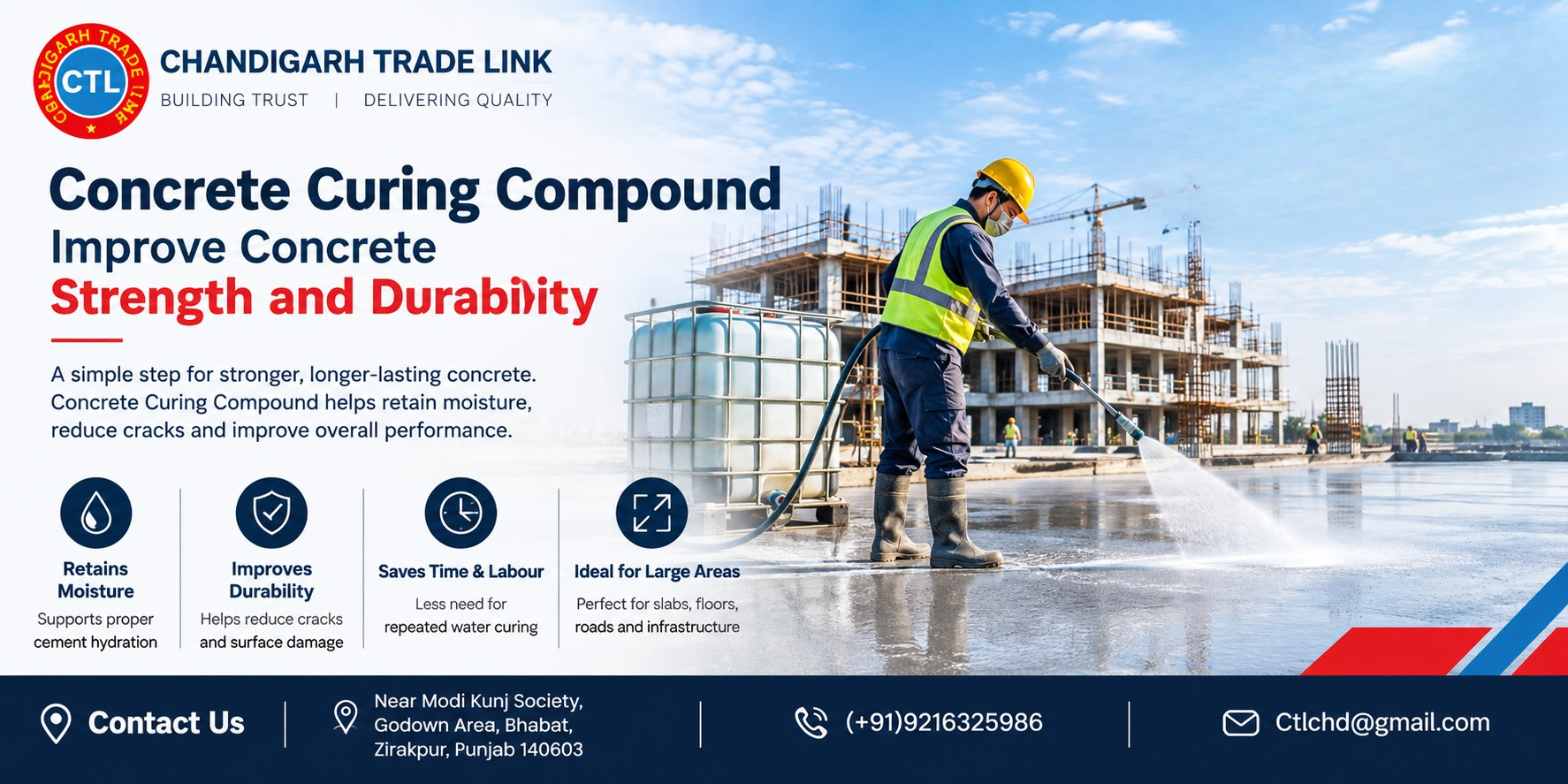
08 Sep Concrete Curing Compound by Chandigarh Trade Link
Concrete Curing Compound: Improve Concrete Strength and Durability
Concrete is one of the most widely used construction materials because of its strength, versatility, and long service life. However, achieving reliable concrete performance requires more than the right mix design and proper placement. Concrete Curing Compound, especially during the early period when concrete needs sufficient moisture for cement hydration. If moisture evaporates too quickly, it can affect strength development, surface quality, and long-term durability.
A Concrete Curing Compound offers a practical solution for controlling moisture loss from freshly finished concrete. By forming a protective membrane over the surface, it helps retain essential moisture during the curing period. This makes curing easier to manage, particularly on large concrete surfaces where continuous water curing can require considerable labour, water, and supervision.
Chandigarh Trade Link provides construction-related products and solutions for contractors, builders, infrastructure companies, engineers, and project owners looking for dependable materials for different construction requirements.
What Is Concrete Curing Compound?
A Concrete Curing Compound is a specially formulated liquid that is applied to a freshly finished concrete surface. It creates a thin protective film or membrane that reduces water evaporation and helps retain the moisture needed for cement hydration during the early curing period.
Traditional curing can involve repeated watering or wet coverings, which can be difficult on large exposed areas. Where it is difficult to maintain a continuously wet surface, curing compounds may be an effective alternative.
It can be applied by suitable spray equipment, roller or other recommended method. Coverage is even important.
Why Proper Concrete Curing Matters
Cement reacts with water, which is why concrete gets stronger after it is placed. This hydration process is maintained by keeping moisture conditions suitable. Poor curing can result in surface cracking, dusting, low abrasion resistance, poor durability and low strength development.
Concrete Curing Compound Can be used to help reduce evaporation of moisture by forming a membrane over exposed surface. This is especially useful for large slabs, industrial floors, roads, bridge decks, parking areas and other surfaces where repeated watering may involve significant labour, water, supervision and time.
Key Reasons Proper Curing Is Important
- Helps maintain moisture during early cement hydration
- Supports concrete strength development
- Helps reduce surface cracking and dusting
- Improves long-term durability and surface performance
- Reduces challenges associated with rapid moisture loss
Proper curing remains an important part of responsible construction practice.
Major Benefits of Using a Concrete Curing Compound
One important advantage of this curing solution is convenience. Once applied according to the manufacturer’s instructions, it can reduce the need for repeated water application.
- Better Moisture Retention
The membrane formed on the surface helps reduce moisture loss. Better moisture retention supports cement hydration and contributes to consistent concrete development. - Reduced Dependence on Water
Large projects may require considerable water for traditional curing. A curing compound can reduce dependence on continuous water application where permitted. - Lower Labour Requirements
Water curing often requires workers to repeatedly wet surfaces or maintain wet coverings. A suitable curing compound can simplify site operations and reduce labour associated with repeated watering. - Suitable for Large Areas
Industrial floors, warehouse slabs, concrete pavements, airport surfaces, bridge decks, and broad slabs can be difficult to cure continuously with water. Applying a curing compound can make coverage more practical across large areas. - 5. Supports Durability
Proper moisture management during early hydration supports concrete strength development and long-term performance. Consistent curing can help concrete achieve the properties expected from the specified mix.
Where Can Concrete Curing Compound Be Used?
Depending on the product selected and project needs a Concrete Curing Compound can be appropriate for many construction applications. Common applications include concrete roads & highways, industrial floors, factory floors, warehouse slabs, parking areas, bridge decks, airport pavements, concrete channels, retaining structures, commercial construction, residential slabs, precast components, infrastructure projects and large RCC surfaces.
It is especially helpful where there are large horizontal surfaces that are difficult to keep wet covered or continuously water cured. Contractors should verify that the concrete is compatible with coatings, toppings, flooring systems, waterproofing layers, adhesives or any other treatments planned for the concrete prior to application.
How Does It Work?
A Concrete Curing Compound when uniformly applied to newly finished concrete forms a film which retards the rate of moisture loss to the atmosphere. As cement hydration requires water, keeping moisture provides conducive conditions for concrete to continue developing.
The timing of application is important. The compound should be applied after completion of the stage specified by the manufacturer. Consideration should also be given to temperature, wind, humidity, sunlight and coverage rate.
How to Apply It Correctly
Always respect the application procedure of the technical data sheet of the selected product. Complete the concrete surface in accordance with the project specification. Prepare the compound as required (e.g. mix or dilute if necessary)
Apply Concrete Curing Compound uniformly using approved spraying equipment, roller or other recommended method. Cover completely, paying special attention to edges, corners, exposed zones and areas exposed to wind or direct sunlight.
Important Application Points
- Follow the manufacturer’s recommended application rate
- Ensure uniform coverage across the entire concrete surface
- Pay special attention to edges, corners, and exposed areas
- Consider temperature, wind, humidity, and direct sunlight
- Check compatibility before applying coatings or flooring systems
After application, protect the treated surface from unnecessary disturbance while the curing membrane develops. Workers should follow product-specific safety instructions and use appropriate personal protective equipment.

Concrete Curing Compound vs Traditional Water Curing
Both methods are designed to help with moisture retention, but they do it differently. Water curing is the process of applying water continuously or intermittently to concrete. If used properly it can be effective, but it requires a good water supply and continuous supervision.
A Concrete Curing Compound , however , forms a membrane on the surface of the concrete that inhibits evaporation . This can make curing easier for large or remote sites or projects where it is not practical to maintain a continuous wet surface.
How you do this properly will depend upon the project specifications, the concrete mix, site conditions, exposure, engineering requirements, any further surface treatments, and the applicable standards.
Factors to Consider When Selecting a Curing Compound
Different construction projects require different things. Before purchasing a curing compound, take into consideration the type of concrete surface, weather conditions, location of the application, level of traffic anticipated, specifications of the project and any compatibility requirements.
Also look at the recommended coverage rate and the application procedure. Determine whether the curing membrane should be removed if you are installing coatings, epoxy flooring, tiles, waterproofing materials, paints, screeds or adhesives later or if the formulation you choose is compatible with the next layer.
Choosing a good Concrete Curing Compound can enhance application efficiency while assisting the project to meet its curing needs.
Why Choose Chandigarh Trade Link?
Chandigarh Trade Link helps customers in need of construction related products and practical solutions. Choosing the right product is more than just looking at prices. Application method, coverage, site conditions, project scale and technical compatibility should be considered by contractors and project managers.
Chandigarh Trade Link can help customers to explore the appropriate options for Concrete Curing Compound as per application, project scale, site conditions and technical requirements, if customers are looking for it.
The company can serve smaller building projects as well as larger commercial, industrial and infrastructure applications. Customers are requested to communicate the details of their projects, their application areas, concrete conditions and expected performances for the proper evaluation of suitability of the product.
Importance of Quality Construction Chemicals
In modern construction, specialised construction chemicals are increasingly being used to improve productivity, durability and project performance. Concrete is a very capable construction material in its own right, but the final properties are largely dependent on the workmanship and care after placement.
The right Concrete Curing Compound can be used as part of a planned curing regime to help improve moisture management and reduce the operational difficulties associated with traditional curing methods.
Best quality materials are combined with proper concrete placement, finishing, curing procedures and good site practices. No one product can make up for poor construction methods, so curing compounds should be used as part of a total quality-control system.
Conclusion
Proper curing is one of the most important steps in concrete construction. If the moisture is lost too quickly during the early hydration the concrete may not perform as expected, even with a well-designed concrete mix.
A Concrete Curing Compound is an effective method to help retain moisture, simplify curing procedures, reduce the need for frequent watering, and ensure even concrete growth. It can be useful for large slabs, industrial floors, pavements, infrastructure works and exposed concrete surfaces.
Chandigarh Trade Link can help contractors, builders, engineers and project owners find suitable construction solutions. Selecting products based on technical needs and applying them correctly allows project teams to realise lasting and dependable concrete results.


No Comments